


Transcatheter Mitral Valve Repair
The mitral valve plays a critical role in proper blood circulation, controlling the flow of blood from the left atrium to the left ventricle of the heart. When this valve is damaged, most commonly in the form of regurgitation, the heart is forced to work harder, gradually leading to heart failure.
Until relatively recently (10–15 years ago), the only solution was open-heart surgery. Today, interventional cardiology offers the possibility of percutaneous mitral valve repair via catheter, providing an exceptionally safe alternative.
What Is Mitral Valve Regurgitation?
Regurgitation occurs when the valve leaflets fail to close completely. As a result, a portion of blood flows back toward the lungs instead of being pumped to the rest of the body. Symptoms include:
- Severe shortness of breath, even at rest
- Fatigue and weakness with minimal exertion
- Palpitations or arrhythmias
- Edema (swelling) of the lower limbs
The Game Changer: MitraClip (Edge-to-Edge Repair)
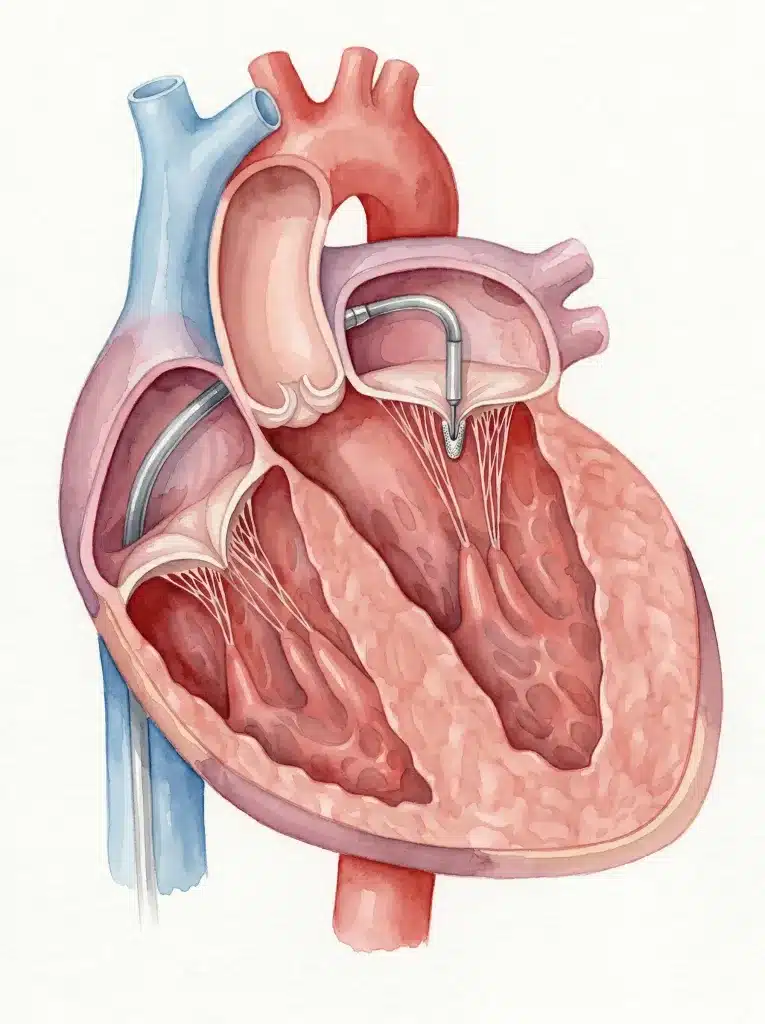
The most widely used and effective technique for percutaneous repair is the MitraClip procedure. This is a minimally invasive approach that "corrects" the valve without stopping the heart.
How does the procedure work?
- Access: The interventional cardiologist introduces a thin catheter through the femoral vein in the leg
- Navigation: Guided by transesophageal echocardiography and fluoroscopy, the catheter reaches the left atrium
- Placement: The MitraClip — a miniature clip-like device — is positioned on the valve leaflets. The device "grasps" both leaflets at the site of the leak and joins them together, creating a double-orifice valve that now closes effectively
Beyond MitraClip: TMVR and Balloon Valvuloplasty
Depending on the anatomy and nature of the lesion, percutaneous valve repair may also involve other techniques:
- TMVR (Transcatheter Mitral Valve Replacement): In cases where repair is not feasible, a new bioprosthetic valve is implanted within the existing one — entirely percutaneously
- Balloon Valvuloplasty: Used primarily for mitral stenosis, where a balloon dilates the narrowed orifice to restore blood flow
[Image Placeholder: Σχηματική απεικόνιση της τοποθέτησης MitraClip στη μιτροειδή βαλβίδα]
Why Choose the Percutaneous Approach?
The percutaneous approach performed by Dr. Thanos Kolyviras offers significant advantages, particularly for high-risk or elderly patients:
- No thoracotomy: No large chest incision is required, significantly reducing post-procedural pain
- Rapid recovery: Most patients are mobilized the same day and return home within 48 hours
- Immediate improvement: Reduction in regurgitation provides immediate relief from shortness of breath, improving quality of life from the very first days
- Safety: The procedure is performed without cardiopulmonary bypass, making it ideal for patients with comorbidities
Expertise and Care at Metropolitan General
Every case of mitral regurgitation is unique. At Metropolitan General, our team uses state-of-the-art technology for pre-procedural planning (3D Echo, CT), ensuring that device selection and positioning achieve the best possible outcome.
Mitral valve repair is not simply a medical procedure — it is a commitment to restoring the patient's quality of life. We are here to evaluate your condition and discuss whether you are a candidate for this pioneering treatment.