


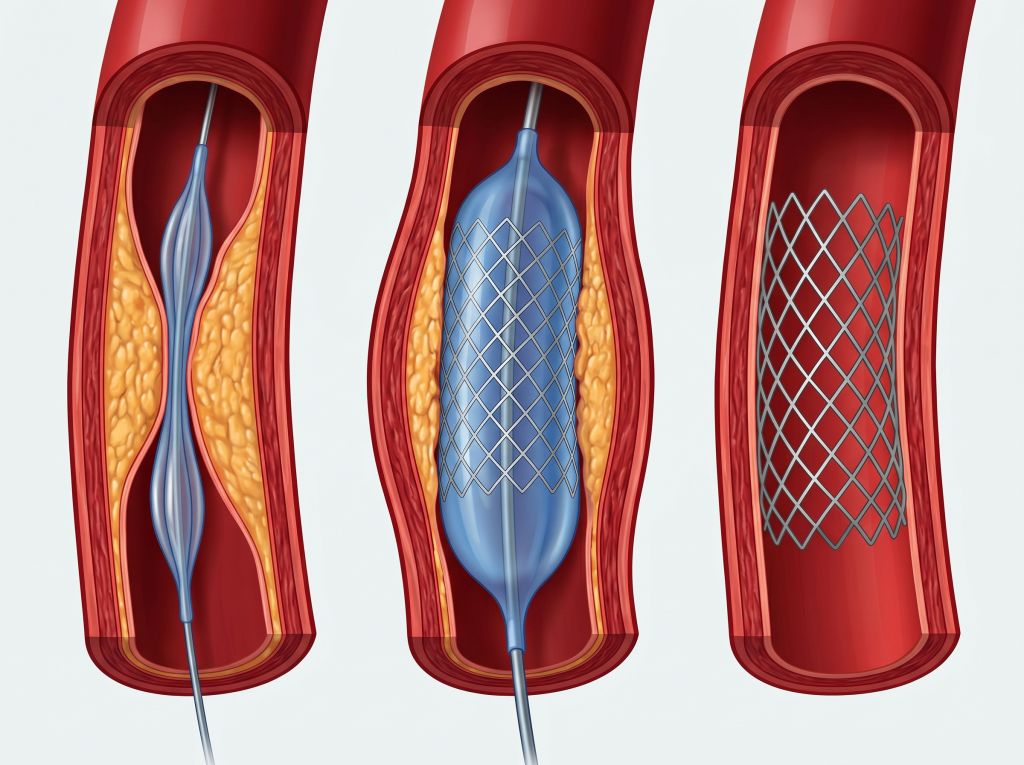
Coronary Artery Angioplasty
Coronary Artery Angioplasty
How is the procedure performed?
Coronary artery revascularization is typically performed immediately following coronary angiography, once the culprit lesions have been identified.
- Radial access: The procedure is performed via the radial artery in the wrist; a minimally traumatic approach requiring only local anesthesia
- Immediate recovery: After the procedure, the catheter is removed and a simple hemostatic compression band is applied for approximately 2 hours
- Hospitalization: You will need to remain in hospital for 24 hours for monitoring and can return home the following day
Stent Technology: From metal to bioresorbable
Stent implantation is the key to keeping the vessel open. We use technological advances that dramatically reduce the likelihood of restenosis:
- Drug-Eluting Stents (DES): Modern stents coated with a medication that is released gradually
- Drug-Coated Balloons (DCB): An innovative solution that allows treatment of stenosis without implanting a permanent stent. The specialized balloon delivers the drug directly to the arterial wall within seconds, preventing restenosis and leaving the vessel free of any foreign body
- Bioresorbable Vascular Scaffolds (BVS): The latest word in technology. These stents maintain vessel patency and then are fully resorbed over time. Your artery remains free, retaining all the properties of a healthy vessel with no permanent foreign body present
Expertise in Complex Lesions (CTO and Atherectomy)
Beyond standard procedures, Dr. Thanos Kolyviras specializes in treating particularly complex cases that previously required bypass surgery.
1. Chronic Total Occlusion (CTO)
Involves arteries that have been completely blocked for an extended period of time.
- The procedure: Specialized, extremely fine guidewires and state-of-the-art microcatheters are used, through which the physician creates a new channel through the occluded segment
- The outcome: Recanalization of the artery is achieved without bypass surgery, immediately improving myocardial perfusion and exercise tolerance
2. Rotational Atherectomy (Rotablator)
Applied when stenoses are heavily calcified and the vessel cannot be dilated with a standard balloon.
- The procedure: A miniature diamond-tipped burr rotating at high speed is used
- The outcome: The technique ablates the calcified plaque, preparing the artery for optimal stent expansion and apposition, ensuring a stable and durable result
3. Intravascular Lithotripsy (Shockwave)
The most advanced technique for managing calcification, using technology similar to that applied in kidney stone treatment.
- The procedure: A specialized balloon emits acoustic pressure waves (shockwaves) precisely at the site of stenosis
- The outcome: The waves create micro-fractures in the hard calcium deep within the arterial wall, restoring its elasticity, allowing the stent to be deployed with complete precision and safety
Questions or Ready to Book an Appointment?
If you would like to learn more about angioplasty or discuss the plan for your procedure, you can visit the FAQ page or schedule your appointment here.